
Tag: fossil fuel

  • What is Carbon Footprint (Co2 emission)?

    What is Carbon Footprint (Co2 emission)?

    “Carbon footprint” refers to the total amount of carbon dioxide (CO2) emissions produced by an individual or organisation (e.g., building, corporation, country, etc.). It factors in both direct and indirect emissions, the former coming from the burning of fossil fuels in production, heating, and transportation and the latter from the generation of electricity, which is then used in the production of the goods and services that consumers purchase. Beyond carbon dioxide, other greenhouse gases like methane, nitrous oxide, and chlorofluorocarbons are often included in discussions of a “carbon footprint” (CFCs).

    Ecological footprints were first proposed in the early 1990s by Canadian ecologist William Rees and Swiss-born regional planner Mathis Wackernagel at the University of British Columbia. It was from the idea of an ecological footprint that the concept of a carbon footprint grew. An ecological footprint is the total area of land needed to sustain a given population or activity. Considerable quantities of both water and land are required for food production. Conversely, a carbon footprint is typically presented as a weight, such as tonnes of CO2 or CO2 equivalents produced annually.

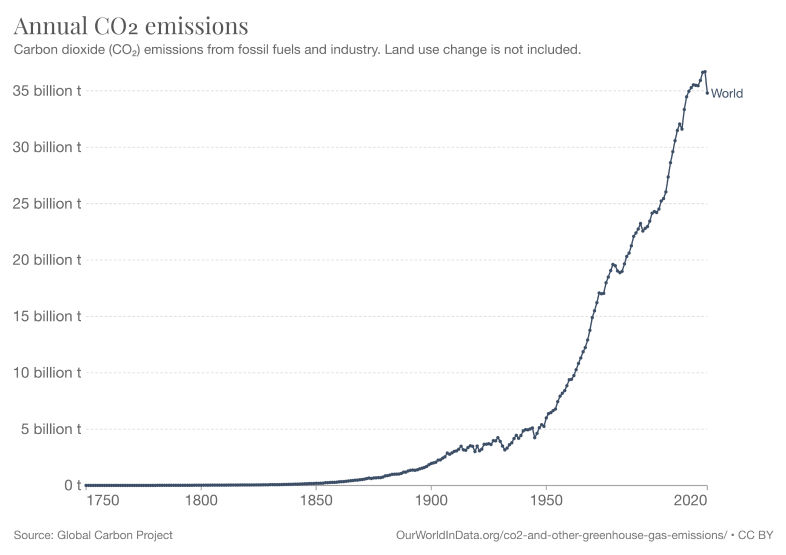
    How has the historical pattern of carbon dioxide (CO2) emissions changed around the world?

    From the middle of the 18th century to the present day, global emissions are shown to have steadily increased.

    We can see that emissions were significantly lower before the Industrial Revolution. Up until the middle of the twentieth century, emissions growth was slow. In 1950, human activity caused global CO2 emissions of 6 billion tonnes.

    More than 22 billion metric tonnes were produced by 1990, more than four times as much as in 1970. There has been a rapid increase in emissions, and we now produce more than 34 billion tonnes of pollution annually.

    While emissions growth has slowed in recent years, they have not yet reached their maximum level.
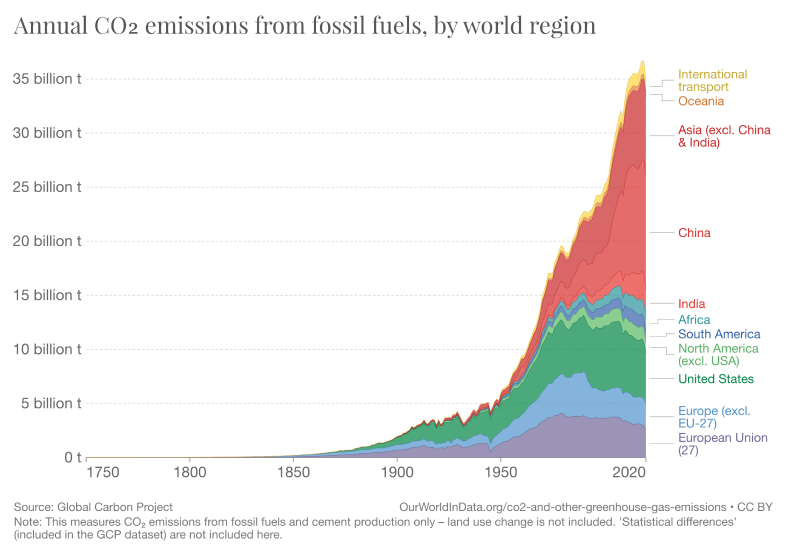
    We can see how the carbon emission has region-wise in last few decades. Europe and the United States dominated global emissions until the late twentieth century. From 1900 to 1950, Europe and the United States accounted for over 85% of annual emissions; by 2000, that number had only slightly decreased.

    Recent decades, however, have seen a dramatic shift in this regard.

    As the 20th century progressed, the rest of the world saw a dramatic increase in its emissions, especially in Asia and, most notably, China.

    Only about a third of emissions come from the United States and Europe.
    Which country or region produces the most CO2 annually per capita?

    When we divide a country’s total emissions by its population, we get an estimate of what each country’s citizen of that country contributes. This gives us an estimate of CO2 output per person.

    The said analysis focuses on emissions generated within national borders, independent of international trade in goods. What happens to these numbers when we factor in international trade is the subject of much larger discussion basis the consumption-based emissions. Production numbers matter because they are used to set climate goals. Thanks and thanks to historical reconstructions, we have global production data for the entire planet dating back to the middle of the 18th century.

    Emissions per person vary significantly from one region of the world to another.

    Major oil producers are also among the world’s highest per capita CO2 emitters, especially those with small populations. They are primarily located in the Middle East: With 49 tonnes (t) per capita emissions in 2017, Qatar ranked first, followed by Trinidad and Tobago (30 t), Kuwait (25 t), the United Arab Emirates (25 t), Brunei (24 t), Bahrain (23 t), and Saudi Arabia (19t).

    To counteract this, many of the world’s top oil producers have small populations and thus low total annual emissions. The United States, Australia, and Canada are all highly populated countries with correspondingly high levels of total emissions due to their high per capita emissions. Australia has the largest average footprint, at 17 tonnes per person, followed by the United States (16.2 tonnes) and Canada (15.6 tonnes).

    The 2017 worldwide average was only 4.8 tonnes per person, which is more than three times higher than that. It stands to reason that countries with high standards of living also have a large carbon footprint, as there is a strong correlation between GDP and CO2 emissions per person. It becomes apparent, however, that countries with similar living standards can have vastly different per capita emissions. Numerous European countries, for instance, produce fewer greenhouse gas emissions than either the United States or Canada.

    The emissions of some European countries are not too far above the global average: There were 5.3 tonnes of emissions per person in Portugal in 2017, 5.5 tonnes in France, and 5.8 tonnes in the United Kingdom. This is considerably less than the sums spent on a similar lifestyle in neighbouring countries like Germany, the Netherlands, or Belgium. The electricity mix varies widely from country to country, depending on factors such as the share of electricity generated by nuclear and renewable sources. As a result, fossil fuels generated caused a much smaller percentage of electricity; in 2015, only 6% of France’s electricity came from fossil fuels, while that percentage was 55% in Germany.

    Clearly, policy and technological decisions make a difference, but prosperity is still the primary driver of CO2 emissions.

    There are still many countries with relatively low CO2 emissions per person. The annual average footprint is around 0.1 tonnes in many of the poorest countries in Sub-Saharan Africa, including Chad, Niger, and the Central African Republic. Compared to the United States, Australia, and Canada, that is over 160 times lower. It takes a Malian or Nigerien a whole year to equal what the average American or Australian emits in just 2.3 days. India’s average carbon footprint is 2.8 tonnes.

    Think about this:

    One of the significant aspects of carbon emission in today’s digitally evolved world is the average usage of technology by the country’s population of each count. With the rise of 5G data and smartphones in every remote area of the world, carbon emission has increased. It is we who need to understand development comes at a cost, and we must create harmony while we soring high the waves of development.

    It is possible to neutralise carbon and create a much more harmonious world by evaluating and understanding the impact of carbon emissions on an individual level. If we all do our part, the world we leave for future generations will be much better than the one we inherited.
  • This 1920s Inventor Sped Up Climate Change With His Inventions

    This 1920s Inventor Sped Up Climate Change With His Inventions

    While many technologies have helped people and advanced society, others once hailed as breakthroughs today have detrimental implications. Once-wonderful insecticide DDT had far-reaching harmful consequences on the ecosystem, as did plastic packaging. Two innovations—leaded gasoline and chlorofluorocarbons—cause the most harm (to human and planetary health) (CFCs). 

    Thomas Midgley Jr., a chemical engineer from Beaver Falls, Pennsylvania, who wore glasses, invented both.

    Low-quality gasoline at the turn of the century caused engines to knock, reducing performance and economy and often causing mechanical failure. In 1916, Charles Kettering, inventor of the electric starter, asked Thomas Midgley to produce a gasoline additive that would boost car engine performance. Midgley opted for ethanol after many fruitless efforts (the same ethyl alcohol found in wines and spirits). Midgley patented an alcohol-gasoline anti-knock fuel in 1920.

    Midgley and Kettering hailed ethanol as the “fuel of the future,” but they couldn’t patent the technique and couldn’t profit from it. Prohibition made it easier for farmers to produce ethanol from corn, which increased home distillation. Further, ethanol’s dual purpose as a fuel source made it unpalatable to the oil business, whose support the embryonic automakers sector needed.

    The dark discovery by Midgley

    Midgley and Kettering had moved on to General Motors by this time, and Alfred P. Sloan (often called the “father of planned obsolescence”) had abandoned their attempt to sell gasoline mixed with ethanol in 1921. Sloan’s plan to fight Ford’s Model-T comprised flashier cars with more powerful engines, but engine knock remained a problem. GM sent Midgley back to the lab to build a cheap, profitable gasoline additive.

    The first in the US to include lead was ethyl-branded gasoline. BEV Norton’s fault. The first leaded gasoline in the US was called “Ethyl.” To Norton’s credit Midgley discovered tetraethyl lead in December 1921. (TEL). Karl Jacob Löwig developed TEL in 1853, but Midgley discovered that adding it to gasoline prevents engine banging when a cool flame burns fuel too early. TEL disturbs this process, allowing combustion to occur at the correct time, and enhancing engine compression, speed and fuel economy. TEL was inexpensive to develop and could be trademarked, opening the door to significant income for GM.

    Due to the detrimental health effects of lead, the word “lead” was never used when the first leaded gasoline was introduced in Dayton (Ohio, USA) in February 1923 under the brand name “Ethyl.” This name evoked discarded ethanol.

    First TEL deaths

    Midgley was vice president of the Ethyl Corporation, a collaboration between GM and Standard Oil (now Exxon) that commissioned Dupont to produce “Ethyl fluid” (essentially TEL plus red dye). Despite the company’s assertion that TEL was safe, numerous states outlawed it after hundreds of workers hallucinated, went insane, and died at a new New Jersey factory.

    Midgley held a press conference in 1924 to tout the TEL’s safety. Source: Wikipedia Midgley praised TEL’s security in 1924. Wikipedia photos

    After recovering from lead poisoning in 1923, Midgley participated in a press briefing on 30 October 1924 to illustrate TEL’s safety. He then rubbed TEL into his hands and inhaled its fumes for 60 seconds in front of the journalists, insisting he would be OK doing this every day and blaming the illness on staff who hadn’t followed safety rules. Midgley knew TEL was toxic. In 1922, DuPont’s chairman described it as a “colourless liquid with a sweetish odour that causes lead poisoning swiftly if absorbed through the skin.”

    Midgley ignored TEL’s risks for its financial benefits. According to his 1925 scientific conference presentation, “tetraethyl lead is the only known material that can achieve these [anti-knock] findings, which are important to the economical use of all automotive equipment by the general population.” He didn’t say he’d altered his view regarding ethanol as an anti-knock component since it burns cleanly.

    Health consequences

    Large corporations convinced the US Surgeon General that the health dangers of lead-tainted gas were insignificant compared to the economic benefits. By 1936, 90% of U.S. gasoline contained ethyl fluid, having quickly surmounted regulatory barriers from states and health agencies. Leaded gasoline became standard globally in later decades. In 2000, Mexico City’s four million cars produced 32 metric tonnes of lead daily.

    People stopped using lead-tainted gasoline in the early 21st century. CC-licensed photo (CC0) Most industrialised nations eliminated leaded gasoline by the early 2000s. Pixabay’s public-domain image.

    Leaded gasoline was a public health hazard. Lead has no physiological use and harms the kidneys and nervous system. It can cause children to lose their IQ and become more aggressive and impulsive. Research links childhood lead exposure to violent criminality.

    In the 1980s, the U.S. began phasing out leaded gasoline as Americans learned of its health risks (only Algeria continues to use leaded petrol today). Due to the widespread usage of leaded gasoline for nearly a century, the metal is now embedded in the planet’s surface, atmosphere, water supply, and human bodies. According to a 1992 research in The New England Journal of Medicine, modern people have 625 times more lead in their skeletons than pre-Columbian North Americans. Leaded gasoline causes 90% of lead poisoning in poor children, according to the WHO. 15 to 18 million youngsters suffer chronic brain damage.

    Discover of Freon

    Thomas Midgley’s next great innovation addressed a problem with General Motors refrigerators of the 1920s. This equipment sometimes emits corrosive gases like sulphur dioxide or methyl formate (highly toxic if inhaled and flammable).

    Under Midgley’s leadership, scientists invented dichlorodifluoromethane, the first chlorofluorocarbon (CFC), a non-toxic, non-flammable refrigerant commercialised Freon-12. Midgley blew out a candle after inhaling the gas to show the American Chemical Society its effectiveness.

    Midgley’s next concept was to fix refrigerators. James Vaughan Midgley’s second invention was refrigerators. Chlorofluorocarbons were first synthesised in 1939 and immediately became used as refrigerants, aerosol propellants, and solvents. Midgley didn’t realise that these gases would blast a hole in Earth’s ozone layer, which absorbs cancer-causing UV light. Even though the CFC-caused gap has stabilised, the situation is still worrying and will take decades to repair.

    Think about this:

    Midgley can be forgiven for the CFC debacle, but tetraethyl lead’s dangers were immediately apparent. Thomas Midgley was honoured for his two discoveries and 170 patents, including ethyl gasoline. Midgley was paralysed by polio in 1940. He was an innovator. Therefore, he let others help him move using ropes and pullies he built. He was strangled to death on November 2, 1944, at age 55. His final idea only injured him, unlike his first two, which were global.